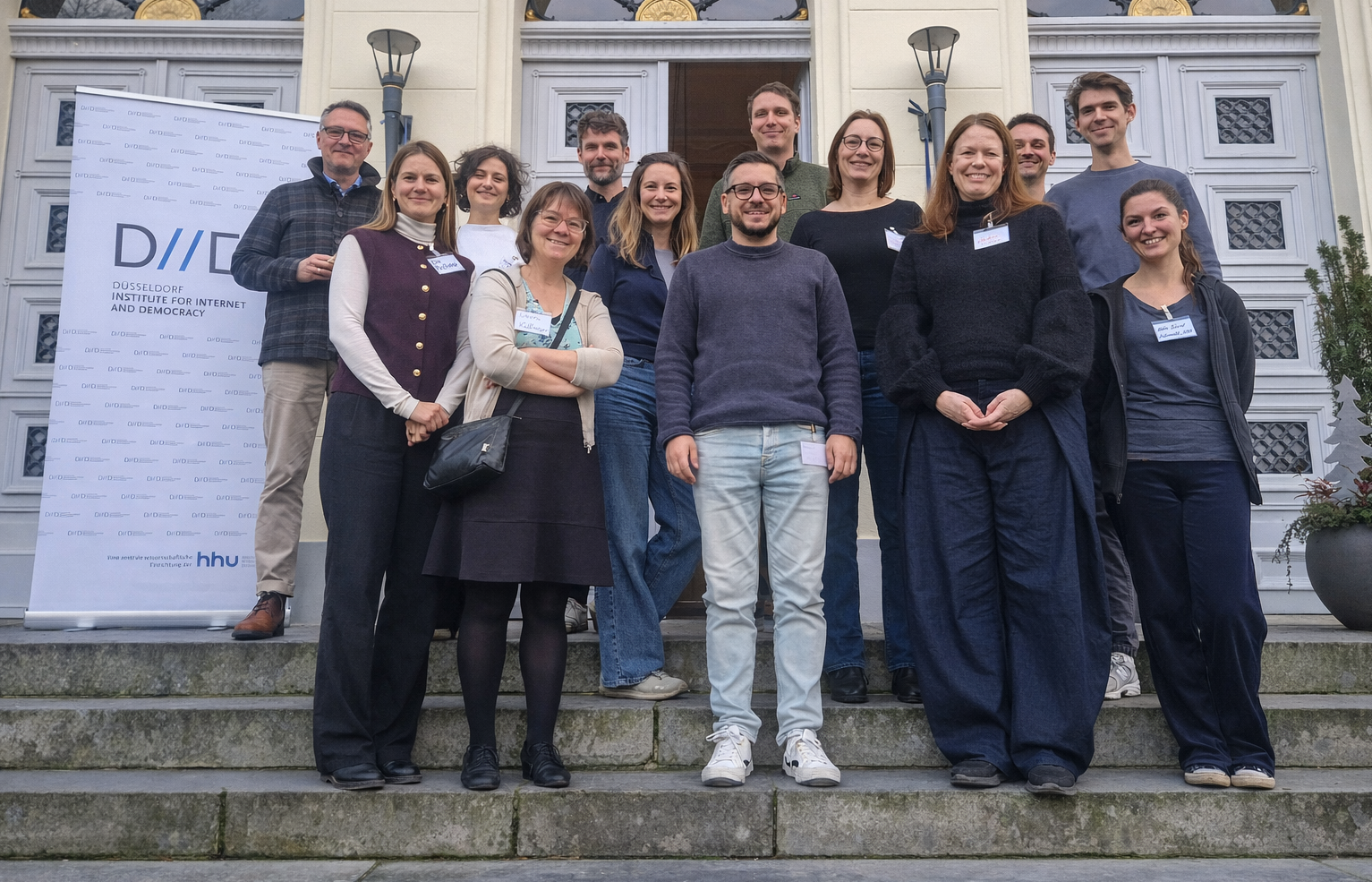
On December 16 and 17 2025, the NewOrder team organised a workshop at Mickeln Castle to exchange and discuss current insights relating to science communication on social and news media, trust in science and scientific information, and changing research and dissemination practices regarding the use of pre-prints vs. peer reviewed information. The workshop was supported by the Düsseldorf Institute for Internet and Democracy (DIID) and the Heine Centre for Artificial Intelligence and Data Science (HeiCAD).
After the welcome by workshop organizer Katarina Boland, a brief round of introductions opened the workshop. Afterwards, Stefan Dietze and Frank Marcinkowski introduced the NewOrder project. Digitalisation was described as a profound transformation process that not only changes the internal structure of science but also re‑orders the relationship between science and society. Thematically, NewOrder addresses, among other things, science communication on social media and the development of public trust in science. The interdisciplinary approach combines expertise from cognitive psychology, the social and communication sciences, and computer science.
Next, Sonja Utz and Eva Rudholzer presented their research on role perception on social media. Their study showed that role cues in social‑media profiles (scientist, journalist, layperson) influenced the credibility of scientific statements, but these cues were often processed only superficially. In an experimental feed, posts by laypeople were judged less credible, while posts by journalists and scientists received similar credibility ratings. When the role cues were removed, this effect almost completely disappeared.
After a coffee break, Nicole Krämer presented, under the title “Dr. Who? Science Communicators in Social Media,” several studies on the trustworthiness of scientists on social platforms. The results indicate that academic titles and increased visibility promote attributions of expertise and integrity, with female scientists being perceived overall as more competent than their male counterparts. Scientific evidence was judged more credible than anecdotal evidence, but it had no direct effect on trust. Comments did not affect credibility; however, scientific evidence posted in negatively charged comment sections led to an increase in trust. Moreover, jargon can reduce understanding and thus credibility, but when it is successfully understood it can actually boost credibility.
The final presentation of the first workshop day was delivered by Julia Mirkin, who offered a philosophical‑theoretical contribution on trust in science. Starting from a philosophical trust concept that distinguishes between a truster and a trustee, she transferred the concept to the relationship among citizens, scientists, and scientific knowledge. She argued that a shift is currently observable—from trust in science toward pseudoscientific actors. To strengthen trust, she identified, on the side of the truster, debunking and pre‑debunking strategies as particularly effective, while on the side of scientists, high‑quality science communication and the avoidance of politicising science are central. Her talk sparked an intensive discussion about the opportunities and risks of involving scientists in political decision‑making.
Katarina Boland closed the first workshop day with a brief summary. The day ended in a convivial atmosphere with a joint dinner and mulled wine.
The second workshop day began with the presentation of a work package by Sebastian Schellhammer on hyper‑partisan headlines in scientific news articles. Using an annotated data set and machine‑learning methods, the team examined how scientific articles are used in journalistic pieces and on social media. The results show that hyper‑partisan headlines appear especially in extreme‑leaning outlets as well as on social platforms (in this case, Twitter). The headlines mainly concern papers about politics, elections, and public opinion (e.g., disinformation), with clear differences between left‑ and right‑wing outlets.
Next, Christian Koß and Frank Marcinkowski discussed the role of preprints in the science and media system. As part of this, they conducted a nationwide survey of 1,100 researchers about the dissemination of preprints in their work. The survey revealed a high willingness to publish preprints, although the frequency varies strongly across disciplines. Preprints are more common in the natural sciences than, for example, in the humanities. Researchers are less concerned about harming the scientific system itself by using preprints; rather, they fear a loss of reputation in the public eye. Nevertheless, the term “preprint” and the surrounding infrastructure are highly heterogeneous, making disciplinary comparisons difficult.
After a short coffee break, an impulse talk by Isabella Peters followed, covering past projects such as DESIVE2, MeWiKo, and VOICES, which dealt with information‑behavior research, scientific handling of disinformation, science communication, and the changed relationship of journalism to the scientific system during and after the pandemic.
The day concluded with a workshop during which the participants successfully identified ideas for joint research papers and planned follow-up research activities.
We thank the DIID and HeiCAD for making this workshop possible, Dennis Frieß for organizational support, Anna-Maria Linnstädt and Till Fahnenstich for on-site support during the event and all participants for the fruitful exchange! We are looking forward to continuing our work together.